
Calathea Care Guide
Goeppertia spp.
Also called Prayer plant, Peacock plant, Rattlesnake plant, Zebra plant
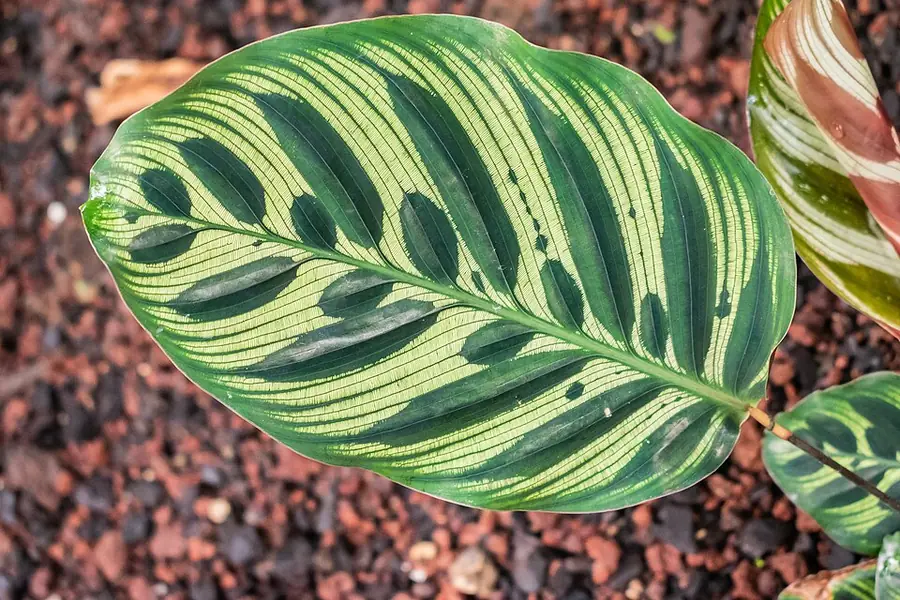
Photo Tournasol7 · CC BY 4.0 via Wikimedia Commons
- Family
- Marantaceae
- Native to
- Rainforest understorey of Brazil and tropical South America
- Mature size
- 1-3 ft tall and wide depending on species
- Toxicity
- Non-toxic to cats and dogs, and one of the safest patterned houseplants for pet homes.
Calathea care at a glance
Light
Medium indirect, never direct
An understorey plant adapted to dappled shade. Direct sun fades the patterns and scorches the leaves within days.
How to measure light at homeWater
Every 5-7 days
Keep evenly moist, never soggy and never bone dry. Use filtered, distilled or rainwater, because calatheas are genuinely sensitive to tap water minerals.
How to water houseplants properlyHumidity
60%+, non-negotiable
The single most important factor. Below about 50% the leaf edges brown and crisp no matter how carefully you water.
Temperature
65-80°F (18-27°C)
Keep above 60°F (15°C) and away from drafts, radiators and air-conditioning.
Soil
Moisture-retentive, well-aerated mix
Peat or coco-coir based mix with perlite. It must hold moisture without compacting into mud.
Fertiliser
Every 4-6 weeks in spring and summer
Quarter to half strength balanced feed. Calatheas burn easily, so under-feeding is safer than over-feeding.
Repotting
Every 1-2 years
Repot in spring, one size up. They resent root disturbance, so be gentle and expect a brief sulk.
How to repot a houseplantPropagation
Division at repotting
Separate the clump into sections, each with roots and several leaves. Cuttings do not work.
Calatheas are the most beautiful difficult plants in common cultivation. The foliage is genuinely spectacular: brushstroke patterns, purple undersides, leaves that rise and fall with the light. They are also unusually specific about humidity and water quality, and they will not quietly tolerate getting either wrong.
Worth knowing before you commit: what most shops sell as Calathea was reclassified into the genus Goeppertia in 2012. The care is unchanged; only the label moved.
Humidity is the whole game
Calatheas come from the rainforest floor, where humidity sits between 70% and 90%. A typical heated home in winter runs at 25-35%.
That gap is why calathea leaves crisp at the edges, and no amount of careful watering compensates for it.
What actually works:
- A humidifier running near the plant. This is the only reliable solution.
- Grouping plants together, which raises local humidity meaningfully.
- A pebble tray: a shallow tray of stones and water under the pot. Modest effect, but real.
- A bathroom with a window, if you have one with enough light.
What does not work: misting. It raises humidity for a few minutes, and wet leaves left standing overnight actually encourage fungal spotting.
Water quality
Calatheas are one of the few houseplants where the water in your tap genuinely matters.
Fluoride, chlorine and dissolved hardness minerals accumulate at the leaf margins as water evaporates, and burn the tissue. The result is the brown edge that people mistake for underwatering.
Use filtered, distilled or rainwater. Leaving tap water out overnight lets chlorine off-gas, but does nothing about fluoride or hard-water minerals, so in a hard-water area it is not enough on its own.
Flush the pot with clean water every couple of months to leach out whatever has accumulated.
Watering rhythm
Keep the soil evenly moist, damp like a wrung-out sponge, never soggy and never fully dry.
That usually means watering every five to seven days, checking with a finger an inch into the soil. If it feels dry at that depth, water. If it feels wet, wait a day and check again.
Both extremes cause visible damage. Dry soil produces curling and crisping; wet soil produces yellowing lower leaves and eventually root rot.
Light
Medium, indirect, filtered. Think of the forest floor under a canopy.
- Good: a north-facing window, or several feet back from an east-facing one
- Acceptable: filtered light through a sheer curtain
- Bad: any direct sun, which fades the patterns and scorches leaves within days
Faded, washed-out markings almost always mean too much light. The colour will not return to damaged leaves, but new growth comes in vivid once you move it.
The nightly movement
Calatheas belong to the prayer plant family, and they move. Leaves rise toward vertical in the evening and lower again in the morning, driven by cells at the base of each leaf stalk that swell and relax on a circadian rhythm.
This is normal and healthy. A plant that has stopped moving is often a stressed one. Do not confuse this vertical folding with the tight lengthwise curling that signals thirst.
Dividing
Calatheas grow in clumps and are propagated only by division, since cuttings do not root.
At repotting time in spring, tip the plant out and look for natural separations in the root mass. Ease the clump apart into sections, each with a good root system and at least three or four leaves. Pot each into fresh moisture-retentive mix.
Expect a sulk. Divisions droop and may drop a leaf or two while they establish. Keep them warm, humid and out of direct light for a few weeks, and they recover.
If this sounds like too much
It is a fair conclusion. If you love the look but not the maintenance, Maranta leuconeura, the true prayer plant, offers similar patterned foliage with noticeably more tolerance for ordinary indoor humidity.
Calathea problems and fixes
| Symptom | Likely cause | What to do |
|---|---|---|
| Brown, crispy leaf edges | Low humidity, or minerals in tap water | Raise humidity above 60% with a humidifier, and switch to filtered, distilled or rainwater. This is the defining calathea complaint. Full guide → |
| Leaves curling inward lengthwise | Underwatering or heat stress | Check the soil, and if dry, water thoroughly. Curling is the plant reducing its surface area to conserve moisture. |
| Faded, washed-out patterns | Too much direct light | Move out of direct sun into bright but filtered light. Colour returns in new growth. |
| Yellowing lower leaves with wet soil | Overwatering | Keep moist, not saturated, and make sure the pot drains. Calatheas want consistent moisture, not standing water. Full guide → |
| Fine webbing and stippled leaves | Spider mites, which thrive in the dry air calatheas hate | Shower the plant, treat weekly with insecticidal soap for three weeks, and raise humidity to prevent recurrence. Full guide → |
Calathea FAQs
Why does my calathea have brown crispy edges?
Two causes, usually together: humidity below about 50%, and minerals or chlorine in tap water. Calatheas evolved in rainforest understorey at 70-90% humidity, and they accumulate tap water salts at their leaf margins. Run a humidifier near the plant and switch to filtered, distilled or rainwater. Existing brown edges will not heal, but new leaves will come in clean.
What water should I use for a calathea?
Filtered, distilled or rainwater. Calatheas are among the most tap-water-sensitive common houseplants: fluoride, chlorine and hard-water minerals all cause leaf-edge burn. Leaving tap water out overnight removes chlorine but not fluoride or dissolved minerals, so it is only a partial fix in hard-water areas.
Why is my calathea curling its leaves?
Curling inward along the length of the leaf is a moisture-conservation response, usually meaning the soil has dried out too far or the plant is too warm. Check the soil and water thoroughly if dry. Note that calatheas also raise and lower their leaves daily on a natural rhythm, and that vertical movement at night is normal and not a problem.
Are calatheas safe for cats and dogs?
Yes. Calatheas and their close relatives in the Marantaceae family are non-toxic to cats, dogs and horses. They are one of the few genuinely dramatic, patterned houseplants that are safe for a pet household, which is much of their appeal.
Is a calathea a good beginner plant?
Honestly, no. Calatheas are demanding about humidity and water quality in ways that most houseplants are not, and they show their displeasure quickly and visibly. If you want the same look with far less effort, a prayer plant (Maranta leuconeura) is more forgiving, and a pothos or philodendron more forgiving still.
Related care guides
Published by Plantive · Published July 1, 2026 · Updated August 16, 2026